The standard nightmare scenario
The Robot Who Looked Like MeThe standard nightmare scenario is Earth’s recurring template for first contact: a human expedition encounters a powerful alien civilization, and the aliens take over. Its force lies in the gap between the hope of finding intelligent neighbors and the fear that those neighbors may be stronger, faster, more aggressive, and able to dictate what happens to humanity. Johnny Bezique’s approach to Loris brings the template to life, but at the point the scene stops, neither the aliens’ intentions nor the contest’s outcome is known.
The Scenario and Its Premise
The scenario begins with a strategic argument for exploration. Earth sends expeditions outward because, if other life exists, humanity would rather find it first than have it arrive unexpectedly. Discovery is therefore imagined as a possible advantage, but not as reassurance: making contact with an intelligent civilization raises the question of which side will hold power. The narrator reduces that anxiety to a contest over who will be on top, presenting the nightmare as a problem of relative strength and control rather than simply the shock of learning that life exists elsewhere.
The feared sequence is stable even when its details change. Earth meets a powerful civilization, and that civilization takes over. The scenario is not a record of an invasion already shown to have occurred; it is a recurring expectation against which the first-contact scene is read. At Loris, the pattern has begun, but the evidence has not yet established that the encounter will end in conquest.
Variations on the Threat
The imagined invaders do not have one fixed nature. In some versions they possess superior machinery; in others, extraordinary mental powers. They may instead be physically difficult to defeat, like the hypothetical walking plant-people, or arrive as swarming insect people. These alternatives change the form of the danger, but not its essential direction: Earth faces an opponent that can overpower it.
The scenario also reverses the expected moral alignment. The narrator contrasts the ruthlessly amoral aliens of the nightmare with Earth’s self-image as the good side. Yet moral confidence does not settle the contest. Whether the aliens are technologically advanced, mentally formidable, or nearly invincible, the decisive concern remains what they can do to humanity. Their imagined variety makes the nightmare adaptable, while the anticipated takeover gives every version the same conclusion.
Johnny Bezique’s First Contact
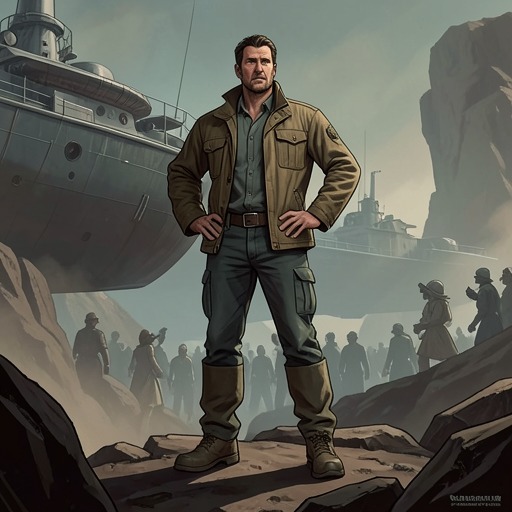
The pattern starts when Johnny Bezique, a spaceship-driver for SBC Explorations, Inc., surveys a previously unexplored fringe of the Seergon Cluster. The first four planets reveal nothing interesting. Near the fifth, a voice apparently activates his ship’s loudspeaker remotely, identifies the planet as Loris, and presumes that he intends to land. It then offers to send landing orbit, speed, and other pertinent data directly to his ship’s computer. Bezique agrees. The encounter begins not with visible violence but with an unexplained voice and an alien capacity to communicate with, and provide instructions to, the human vessel.
The ship’s control panel registers an immediate change in course and velocity, and Loris appears on the viewplate in blue, green, and brown. The voice’s fluency in English and its command of the landing information establish an impressive, if limited, technological and communicative advantage. They do not by themselves prove hostile intent. The offer can be read as assistance; within Earth’s nightmare template, however, the same unexplained control over the encounter makes the disparity between visitor and host impossible to ignore.
The narrator identifies this as Earth’s first contact with alien life and says that this is how the standard nightmare always begins. That framing gives the ordinary mechanics of approach—an announcement, a proposed landing, a change of trajectory—the weight of a familiar threat pattern. Bezique is described as mechanically competent, fearless, profane, and supported by aggressive self-confidence and ignorance. The comparison to Cortez and the Conquistadores sharpens the point: explorers may proceed into what others consider impossible because they do not recognize the limits of their own position. Bezique’s confidence helps explain why he continues toward an unknown world; it does not tell the reader whether confidence is warranted.
Unresolved Contest
The scenario’s suspense comes from a question the scene deliberately leaves open: can the aliens defeat humanity, or can humanity defeat them? The narrator says that the answer is not yet something Bezique would wager on. His arrival has activated the nightmare’s premise, not confirmed its predicted ending. The distinction preserves tension between the anticipated takeover and the possibility that this particular contact may unfold differently.
The concept therefore organizes both fear and attention. It turns a welcoming-sounding transmission into the opening move of a contest whose scale is planetary, while resisting any easy equation between technological superiority and proven aggression. The nightmare may begin whenever Earth meets a formidable civilization; whether it becomes an actual conquest remains to be seen.